
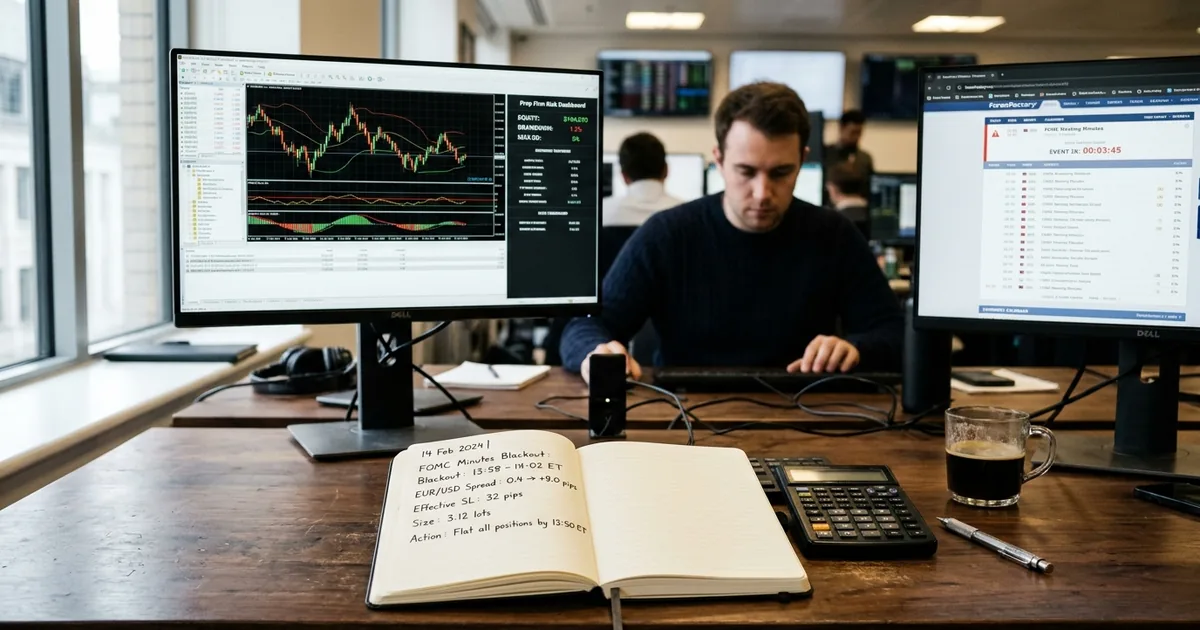
Understanding prop firm news trading rules requires distinguishing between manual trade entry and automated order execution. On standard funded accounts—most notably FTMO—the restricted 2-minute blackout window (2 minutes before to 2 minutes after a high-impact release) applies to every order event, including pre-existing Stop Loss (SL) and Take Profit (TP) orders. If interbank liquidity withdrawal widens spreads from 0.4 pips to 8.0 pips and clips your stop loss inside the blackout window, algorithmic risk monitors flag an illegal order execution, instantly terminating your funded account. Surviving red-folder macroeconomic events requires executing one of three quantitative protocols: closing all intraday exposure 10 minutes prior, switching to an exempt Swing account tier, or calculating a spread-adjusted stop buffer using our news-adjusted lot sizing equation.
How do prop firm news trading rules work on funded accounts?
Direct Answer: Prop firm news trading rules restrict executing any trade—including manual entries, pending orders, and automated Stop Loss or Take Profit fills—within a strict 2-minute to 5-minute window surrounding high-impact macroeconomic releases on affected currencies.
When active traders transition from demo evaluations to live funded accounts, macroeconomic news rules represent the single most common cause of sudden account termination. Most proprietary trading firms enforce strict execution blackouts surrounding high-impact economic data releases—such as the Federal Open Market Committee (FOMC) interest rate announcements, US Consumer Price Index (CPI), and Non-Farm Payrolls (NFP). These blackout windows typically span from 2 minutes before to 2 minutes after the scheduled announcement time, creating a total 4-minute operational freeze on standard accounts.
The fatal misunderstanding among retail traders lies in what constitutes a rule violation. Beginners assume the restriction only prohibits clicking buy or sell manually during the news release. In institutional reality, firms like FTMO define any order execution on the broker server as a violation. This includes pending buy-stop and sell-stop orders, limit orders, and critically, automated Stop Loss (SL) and Take Profit (TP) orders. If you opened a trade two hours prior to the release, holding it is technically permitted—but if market volatility spikes and your Stop Loss fills inside that 4-minute window, the risk engine records an illegal execution, resulting in immediate account termination.
The scope of these restrictions is strictly currency-specific. When a US macroeconomic event lands, the execution blackout applies to all currency pairs containing the US Dollar (such as EUR/USD and GBP/USD), precious metals quoting in USD like Gold (XAU/USD), and US equity index CFDs like the Nasdaq 100 (NAS100) and Dow Jones (US30). Conversely, unrelated cross pairs—such as EUR/GBP or AUD/NZD—remain entirely unrestricted because their underlying liquidity pools do not experience immediate Federal Reserve order book vacuums. Traders can verify pip values across these non-USD crosses using our Global Pip & Point Value Calculator.
Evaluation phases operate under completely different legal and commercial incentives. During the initial FTMO Challenge and Verification stages, or equivalent evaluation combines across modern prop desks, news trading restrictions are generally suspended. Firms allow evaluation candidates to trade through high-impact news because rapid market swings accelerate combine failure rates and fee generation. The moment a trader passes verification and signs a professional funded agreement, the firm shifts risk to live liquidity providers, immediately activating strict automated compliance filters.
This dynamic mirrors the compliance traps detailed in our review of FTMO consistency rules and profit caps. Risk desks design automated algorithms to filter out latency arbitrage, spread exploitation, and unhedged news gambling. Traders who fail to respect the boundary between combine freedom and funded discipline find their funded certificates revoked on their very first red-folder event.
What is the difference between a soft breach and a hard breach in news trading?
Direct Answer: A hard breach results in immediate account closure and permanent forfeiture of funded capital (enforced by FTMO Standard accounts), while a soft breach deducts any profits made from the prohibited trades while keeping the account active (enforced by Funding Pips Master accounts and The 5%ers).
Proprietary firms enforce two fundamentally divergent penalty philosophies when traders execute orders inside restricted news windows: hard breaches versus soft breaches. Understanding which model governs your funded contract determines whether an accidental order fill ends your funded career or merely reduces your session profit split.
On FTMO Standard Funded Accounts, executing any market order or having an automated Stop Loss or Take Profit triggered between 2 minutes before and 2 minutes after a red-folder event constitutes a material breach of the FTMO Account Agreement. The firm's risk engine initiates an immediate hard breach. The account is permanently revoked, open positions are liquidated by the server, and the trader forfeits all accumulated profit splits and refundable evaluation fees. No warnings or manual appeals are granted.
In contrast, firms like Funding Pips operate a soft breach framework across their standard Master accounts (1-Step Flex, 2-Step Standard, and 2-Step Pro). Funding Pips enforces a wider 10-minute total blackout (5 minutes before to 5 minutes after high-impact events and scheduled speeches). If a trader opens or closes a position inside this 10-minute window, the account is not terminated. Instead, the firm executes a soft breach: all profits generated from the restricted trades are deducted from the account balance, while any losses incurred remain 100% the trader's responsibility. Furthermore, Funding Pips provides a structural "5-Hour Rule" exception: trades opened 5 hours or more prior to the event are completely exempt, meaning their Take Profit fills or manual closures count toward real profit targets.
The 5%ers implement a trader-friendly hybrid model on their High Stakes funded accounts. The 5%ers prohibit executing new orders (manual market entries or pending stop/limit orders) within a 2-minute before and 2-minute after window. However, unlike FTMO, pre-existing trades are explicitly permitted to hold, and pre-existing Stop Loss and Take Profit orders are legally allowed to trigger without penalty. If a trader violates the rule by placing a new order, it triggers a soft breach where profits are deducted and losses are absorbed. Meanwhile, FundedNext applies a 40% profit split restriction on trades executed within their 5-minute news window.
Navigating these diverse contractual rules requires active traders to maintain rigorous balance sheet buffers. Just as managing capital inside trailing drawdown liquidation cushions demands sizing against active risk boundaries, news compliance requires calibrating your trading schedule strictly against broker server clocks.
Why does interbank spread widening trigger premature stop losses during news?
Direct Answer: Seconds before major economic data lands, Tier-1 interbank liquidity providers withdraw resting limit orders to manage inventory risk. This creates a liquidity vacuum that widens EUR/USD spreads from 0.4 pips to 8.0+ pips and gold spreads by $3.00+, triggering tight stops on the Ask price before market direction is established.
The primary physical engine driving news execution failures is not market directional momentum—it is the interbank liquidity vacuum. In institutional foreign exchange, retail broker platforms do not generate quotes in isolation; they stream pricing aggregated from Tier-1 prime brokers and non-bank market makers. Under normal session conditions, deep order books produce raw spreads as tight as 0.1 to 0.4 pips on EUR/USD and $0.10 to $0.25 on Gold.
Comprehensive empirical research published by the Bank for International Settlements (BIS Papers No. 90) demonstrates that approximately 30 to 60 seconds before scheduled macroeconomic announcements, institutional algorithmic market makers cancel resting limit orders and pull bid-ask depth. Prime liquidity providers refuse to hold unhedged inventory across data prints where headline surprises trigger directional gaps. As available resting volume vaporizes, the spread between the best available Bid and Ask prices blows out violently.
On EUR/USD, a standard raw spread of 0.4 pips regularly expands to 6.0 to 12.0 pips during major events. On Gold (XAU/USD), spreads routinely explode from $0.15 up to $2.50 or $3.50+ per ounce (representing a $250 to $350 cost per standard lot). On equity indices like the Nasdaq 100, interbank index spreads widen by 10 to 25 index points.
This spread blowout creates the classic "Ask-Price Hunt" on long positions. In MetaTrader and cTrader, chart candlesticks are rendered by default using the Bid price. When you enter a buy position, your Stop Loss is an order to sell, which triggers when the Bid price touches your level. But for short positions, your Stop Loss is an order to buy, which triggers when the Ask price touches your level (Bid + Spread). During an economic data release, the Ask price spikes upward by 8 to 10 pips instantaneously. Even if the Bid price on your chart never moves near your stop loss, the ballooning Ask price triggers your stop prematurely.
Compounding spread widening is execution slippage. As documented in our research on NFP position sizing and slippage buffers, when a stop loss executes inside a depleted order book, the broker fills your market order at the next available price. A planned 20-pip stop loss can easily slip to a 28-pip or 32-pip realized loss, destroying risk-to-reward ratios and threatening the prop firm's daily maximum loss limit.
How do you calculate position size with a spread-adjusted stop loss buffer?
Direct Answer: To calculate position size ahead of news, expand your technical stop distance by adding the expected news spread expansion and slippage margin: Effective Stop Distance = Technical Stop + Spread Blowout + Slippage Buffer. Divide your cash risk budget by this effective distance multiplied by pip value.
To trade macro events safely without triggering compliance breaches or suffering catastrophic slippage, traders must transition from standard technical stop sizing to news-buffered risk modeling. Standard position sizing divides cash risk by technical stop distance. During news, technical stop distance represents only a fraction of the real market risk envelope.
The news-buffered position sizing formula introduces two essential quantitative adjustments: the expected interbank spread expansion (\(\Delta S_{\text{news}}\)) and an execution slippage allowance (\(\sigma_{\text{slip}}\)). The Effective Stop Distance is calculated as: Effective Stop Distance = Technical Stop Loss + Expected Spread Expansion + Slippage Allowance. Once the effective stop distance is established, calculate allowed lot volume: News-Buffered Lot Size = Cash Risk Budget / (Effective Stop Distance * Pip Value per Standard Lot).
Consider a practical worked scenario on a $100,000 FTMO Standard Funded Account. The firm enforces a strict 5% ($5,000) daily loss limit. The trader targets a conservative 1.0% single-trade risk budget ($1,000 USD) on EUR/USD ahead of the scheduled Federal Reserve FOMC meeting minutes release. Under quiet market conditions, the technical stop is 20 pips, with a normal raw spread of 0.4 pips. Standard calculation yields 5.00 lots ($1,000 / (20 pips * $10.00/pip)).
If the trader executes 5.00 lots with a rigid 20-pip stop 15 seconds before the 2:00 PM ET print, spread expansion to 7.2 pips pushes the market price directly into the stop. The Stop Loss executes at 1:59:52 PM ET—inside the 2-minute blackout window. FTMO's automated risk monitor detects an execution violation, terminating the $100,000 funded account. Furthermore, 6 pips of slippage produce a $1,360 loss rather than the planned $1,000 risk.
Under the mathematical news-buffered framework, the trader models an expected spread blowout of 8.0 pips and a slippage buffer of 4.0 pips, expanding the effective stop to 32.0 pips (20 + 8 + 4). Sizing against 32 pips produces: Lot Size = $1,000 / (32 pips * $10.00/pip) = 3.12 standard lots. Sizing is downsized by 37.6%, capping worst-case financial loss at exactly $1,000. Traders can automate this mathematical calibration client-side using our Global Position Size Calculator or asset-specific EUR/USD Position Size Calculator.
What are the three professional protocols for managing high-impact news?
Direct Answer: Professional prop traders rely on three structured protocols: Protocol 1 (The Pre-News Flat Rule—closing all intraday positions 10 minutes prior), Protocol 2 (The Exempt Swing Account Strategy—using lower leverage tiers to hold with wide buffers), and Protocol 3 (The Post-News Stabilization Entry—waiting 3 to 5 minutes post-release for spreads to normalize).
Institutional proprietary traders eliminate operational compliance risk by adopting one of three standardized execution protocols before red-folder macroeconomic releases appear on the calendar.
Protocol 1 is the Pre-News Flat Rule. For traders managing Standard FTMO accounts or funded platforms with strict execution termination clauses, this is the only zero-risk protocol. Traders establish a hard operational rule to manually close all open positions 10 minutes prior to the scheduled announcement (e.g., at 1:50 PM ET for a 2:00 PM release). Flatting the account 10 minutes early guarantees that interbank liquidity withdrawals, broker execution queue delays, and premature spread spikes cannot trigger an accidental execution violation.
Protocol 2 is the Exempt Swing Account Strategy. Traders whose trading edges require holding swing positions through macroeconomic catalysts should deliberately select account tiers built for holding. On FTMO, opening an FTMO Swing Account exempts the trader entirely from the 2-minute news restriction. While base leverage is reduced from 1:100 to 1:30 to account for weekend and overnight volatility, swing traders can hold core positions through FOMC and CPI prints without fear of algorithmic termination. Similarly, accounts on The 5%ers allow pre-existing stops to absorb volatility without penalty.
Protocol 3 is the Post-News Stabilization Entry. Rather than attempting to gamble on the initial release tick, professional intraday participants wait 3 to 5 minutes post-announcement before evaluating new order tickets. Within 3 minutes of a data release, interbank liquidity providers re-enter the market, depth of market replenishes, and raw bid-ask spreads compress back toward baseline levels. Sizing a trade on the secondary retracement structure provides clear technical invalidation levels and eliminates the risk of paying 10x spread markups.
Disclaimer: This analysis and calculation framework is provided strictly for educational and risk management purposes and does not constitute financial, investment, or legal advice. Trading proprietary firm combines and leveraged derivatives involves substantial risk of capital loss. Always review your specific firm's current contract addendum and rulebook before executing live market orders.
Institutional Prop Firm News Trading Policy Matrix: Blackout Windows, Execution Rules & Breach Penalties
| Proprietary Firm & Account Model | Enforced Blackout Window | Prohibited Execution Actions | Automated Stop Loss / Take Profit Policy | Violation Penalty Structure | Exemption & Swing Tiers |
|---|---|---|---|---|---|
| FTMO (Standard Funded & Instant Accounts) | ±2 minutes (2 min before to 2 min after scheduled news) | Opening or closing market orders; placing or executing pending orders | Automated SL/TP execution inside window counts as a violation | Hard Breach (Immediate Account Termination & Contract Forfeiture) | Challenge & Verification phases exempt; FTMO Swing accounts fully exempt |
| Funding Pips (Master Accounts: 1-Step & 2-Step) | ±5 minutes (5 min before to 5 min after red-folder events/speeches) | Opening or closing positions on affected currency within window | Triggered trades subject to profit deduction; holding is monitored | Soft Breach (Profits from restricted trades deducted; account stays active) | 5-Hour Rule Exception (trades opened 5+ hours prior exempt); FundingPips Zero is Hard Breach |
| The 5%ers (High Stakes Funded Accounts) | ±2 minutes (2 min before to 2 min after scheduled news) | Executing NEW orders (market buys/sells, pending stops/limits) | Pre-existing Stop Losses & Take Profits ARE permitted to trigger cleanly | Soft Breach (Profits from illegal new orders deducted; losses absorbed by trader) | Hyper-Growth and Bootcamp accounts allow news; bracket strategies prohibited across all tiers |
| FundedNext (Stellar & Express Funded Accounts) | ±5 minutes (5 min before to 5 min after high-impact news) | Market executions and pending orders on affected symbols | SL and TP executions subject to the News Reward Share restriction | Soft Profit Restriction (Only 40% of news profits count; 100% loss liability) | Evaluation challenge accounts exempt; holding allowed across Stellar 2-Step |
“Prop firm news rules do not care why your order executed. If interbank spread widening pushes the Ask price into your Stop Loss inside the two-minute window, the compliance algorithm flags an execution breach. Sizing with spread buffers or flatting before the news is the only mathematical defense against losing a funded account.”
Authoritative Primary Citations & Institutional Standards
- FTMO Trading Objectives & News FAQ — Official rules detailing the 2-minute restricted window, affected currencies, and automated Stop Loss execution policies.
- Funding Pips Official News Trading Policy — Guidelines governing the 5-minute restricted window, Master account soft breaches, and the 5-hour swing holding exception.
- The 5%ers High Stakes Trading Guidelines — Official terms detailing the 2-minute new execution restriction and pre-existing Stop Loss fill permissions.
- Bank for International Settlements (BIS) — Research report (BIS Papers No. 90) on foreign exchange market microstructure and liquidity degradation during macroeconomic releases.
- Federal Reserve Board of Governors — Official FOMC meeting schedules, monetary policy statements, and meeting minutes publication dates.
Frequently Asked Questions
Does a stop loss count as news trading on FTMO?
Yes. On FTMO Standard funded accounts, the 2-minute news restriction applies to every order execution. If a pre-existing Stop Loss or Take Profit is triggered within 2 minutes before or 2 minutes after a high-impact release on the affected currency, it counts as an execution violation and can result in account termination. FTMO Swing accounts are exempt from this restriction.
What happens if your stop loss hits during the 2-minute news window?
On firms with strict execution rules like FTMO Standard, an automated stop loss fill inside the 2-minute window triggers a hard breach for violating the Account Agreement. On firms with soft breach policies like Funding Pips, losses are absorbed by the trader while profits are forfeited. On The 5%ers High Stakes, pre-existing stop losses are explicitly permitted to execute without penalty.
Can you hold open trades through high-impact news on prop firms?
Holding trades through news is permitted on most prop firms provided the trade was opened before the restricted window. However, on firms that treat automated stop loss or take profit fills as prohibited executions (such as FTMO Standard), holding through news exposes you to immediate termination if price volatility or spread widening triggers your order during the blackout.
What is the difference between a soft breach and a hard breach for news trading?
A hard breach terminates your prop firm account permanently, forfeiting all funded capital and fees. A soft breach closes the violating trades and deducts any profits generated during the restricted window, but keeps your funded account active so you can continue trading subsequent sessions.
How does Funding Pips' 5-minute news rule and 5-hour exception work?
Funding Pips enforces a 10-minute blackout window (5 minutes before to 5 minutes after red-folder events) on Master accounts, treating violations as soft breaches where profits are deducted. Under the 5-Hour Rule exception, positions opened 5 hours or more prior to the news event are fully exempt—if they hit a take profit or are closed inside the window, the profits count.
How do you calculate a spread-adjusted stop loss buffer before news?
Calculate your effective stop distance by adding normal technical stop pips, expected interbank spread expansion (typically 6 to 10 pips on EUR/USD or $1.50 to $3.00 on Gold), and an execution slippage margin (3 to 5 pips). Then divide your planned dollar risk budget by this expanded distance multiplied by pip value using FinCalcEdge to determine safe lot size.
Calculate Exact Position Sizes Before Major News Releases
Never let interbank spread widening or unexpected slippage breach your daily drawdown limit. Use FinCalcEdge to model spread buffers and calculate safe lot sizes in real time.
Risk Disclosure & Educational Disclaimer: All mathematical models, calculation formulas, and trade sizing examples provided on FinCalc Edge are strictly for educational and risk demonstration purposes. This content does not constitute financial, investment, or trading advice. Trading foreign exchange (Forex), commodities, and cryptocurrencies involves significant execution and capital risk, including the loss of entire deposited funds.